Ford F-250 vs F-350, Which Super Duty Fits Which Job
If you tow a boat to a remote lake near Nipigon, haul equipment down a logging road, or pull a fifth-wheel camper along Highway 11 in January, you have probably asked yourself one question. Do I need the F-250 or the F-350? Both trucks share the Super Duty name. Both are built dependable. But they […]
If you tow a boat to a remote lake near Nipigon, haul equipment down a logging road, or pull a fifth-wheel camper along Highway 11 in January, you have probably asked yourself one question. Do I need the F-250 or the F-350? Both trucks share the Super Duty name. Both are built dependable. But they serve different purposes depending on what you tow, how much you carry, and where you drive. For the 2026 model year, buyers across the Thunder Bay corridor and Northwestern Ontario will find the answer comes down to your specific workload. Here is what separates the two trucks so you can walk into Brennen Ford knowing which one belongs in your driveway.
How the 2026 Super Duty Lineup Splits
The F-250 sits on a 3/4-ton chassis. The F-350 rides on a heavier 1-ton chassis. That single distinction drives every other difference between the two trucks.
Chassis and Frame
A heavier chassis means the F-350 handles bigger loads. Its frame, axles, springs, and brakes are all rated for greater gross vehicle weight. For the 2026 model year, both trucks share the same cab styles and bed lengths, so the visual differences are subtle. Under the skin, the F-350 is built to take more punishment over longer stretches. That matters up here on Highway 17, on gravel haul roads north of Geraldton, and anywhere the route does not forgive a truck that is under-spec’d for the job.
Wheel Configuration
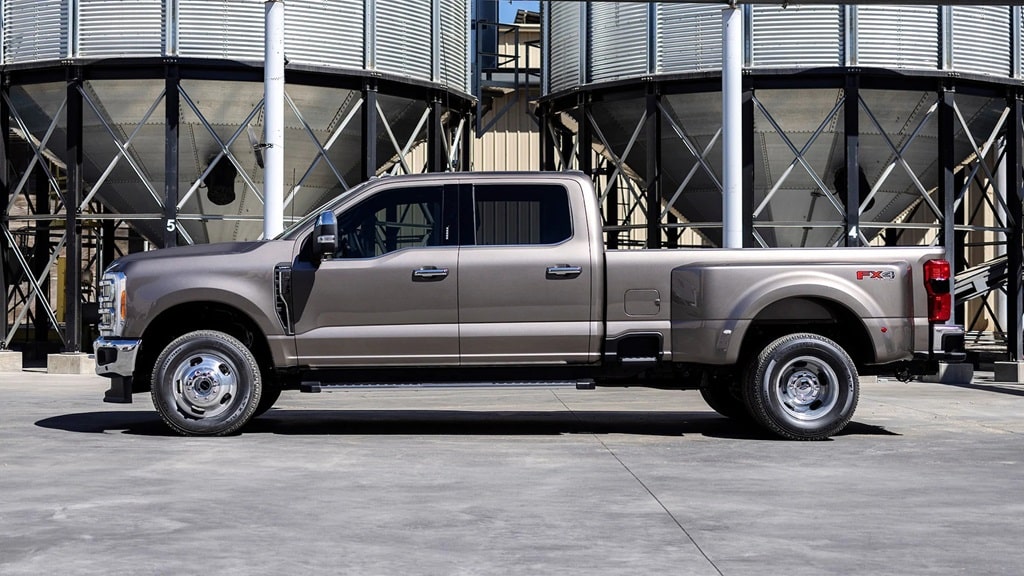
This is where the two trucks diverge sharply. The F-250 is a single-rear-wheel (SRW) truck only. The F-350 comes in both SRW and dual-rear-wheel (DRW) configurations.
A DRW F-350 plants four tires on the rear axle instead of two. That wider footprint delivers greater stability when pulling heavy trailers. It also adds roughly 20 centimetres of width, which matters on narrow back roads and in tighter spots around town. An SRW F-350 gives you a bump in capability over the F-250 without the added width.
The F-350 effectively gives you two trucks in one nameplate. SRW for buyers who want more capacity but still need everyday manoeuvrability. DRW for those who tow at or near the maximum regularly.
F250 vs F350 Powertrain Options for 2026
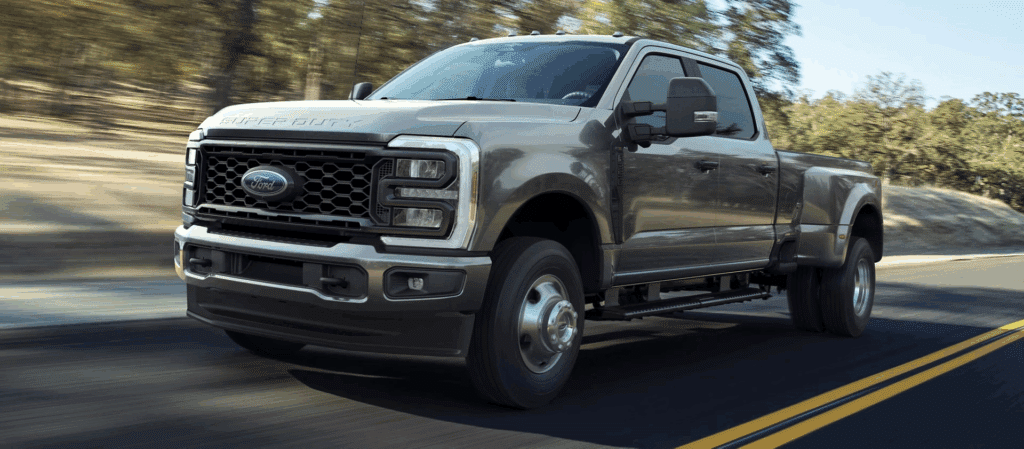
Both the F-250 and the F-350 offer the same engine choices for the 2026 model year. Every engine pairs with the TorqShift-G 10-speed automatic transmission.
Gas Engines
The 6.8L V8 produces 405 hp and 445 lb-ft of torque and handles lighter-duty work well. The 7.3L V8 steps up to 430 hp and 485 lb-ft of torque, suiting buyers who want strong gas-powered performance for consistent towing.
Power Stroke Diesel
The 6.7L Power Stroke V8 turbo-diesel in Standard Output trim delivers 475 hp and 1,050 lb-ft of torque. The High Output version pushes that to 500 hp and 1,200 lb-ft of torque.
Both trucks share these powertrains. The F-350’s advantage lives in its chassis, not its engine. The same diesel in an F-350 DRW can safely handle heavier trailer weights than it can in an F-250, because the frame, axles, and brakes underneath are rated higher. Same engine. Different limits.
Gas or Diesel Up Here
For buyers in Northern Ontario, the gas versus diesel question deserves careful thought. Neither choice is wrong.
When the Diesel Shines
Long highway pulls favour the Power Stroke. If you regularly tow heavy loads between Thunder Bay and Sault Ste. Marie, or haul forestry equipment to remote sites north of Geraldton, that torque output means the engine works less hard over sustained distances. It manages heat and drivetrain stress more efficiently under load.
Diesel also pairs naturally with gooseneck and fifth-wheel setups. Buyers who pull large enclosed trailers or heavy flatdecks tend to gravitate toward the Power Stroke for its low-rpm pulling strength.
When Gas Makes Sense
The 7.3L gas V8 is a strong performer for buyers who tow moderate loads and want simpler maintenance. No diesel exhaust fluid (DEF) to manage. That is a practical consideration when you live far from a major service centre. A buyer towing a fishing boat to Lake Nipigon on weekends may find the 7.3L gas engine perfectly capable without the added upkeep of a diesel.
For any powertrain questions specific to your workload, the team at Brennen Ford’s service department can walk you through what fits best.
Tow and Payload on the F-250 vs F-350
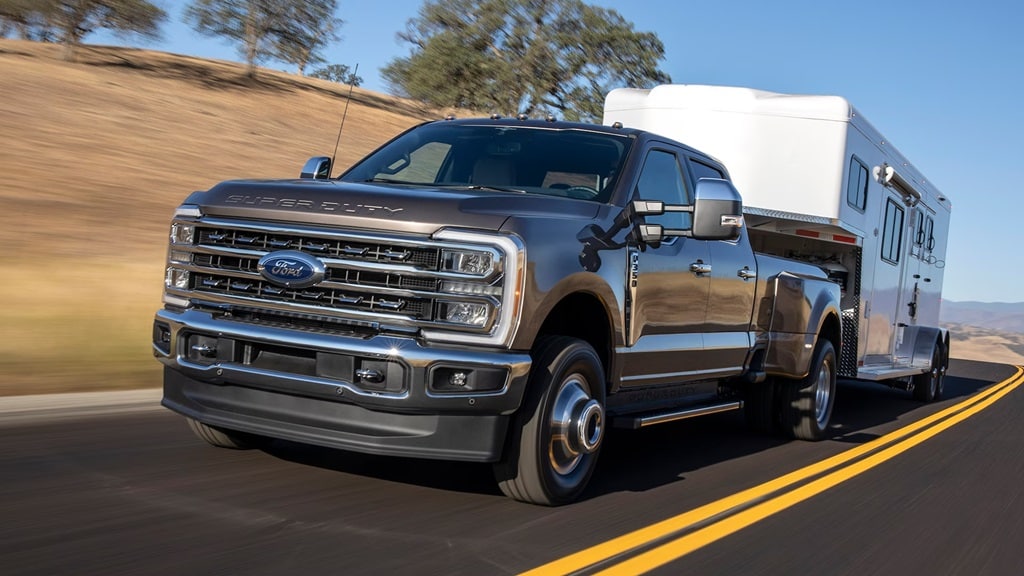
Both trucks are serious towing machines. Specific maximum figures depend on your configuration, including cab style, bed length, axle ratio, engine, and whether you choose 4×2 or 4×4. Ford Canada recommends checking the official Super Duty page on ford.ca for the towing and payload numbers that match your exact build.
What Moves the Numbers
A 4×4 setup slightly reduces maximum towing compared to 4×2, but for Northwestern Ontario winters, 4×4 is essentially mandatory. DRW on the F-350 opens up the highest towing and payload ratings in the lineup. Engine choice matters too. The High Output Power Stroke diesel unlocks the top capability tier.
Gooseneck and Fifth-Wheel Towing
If you pull a gooseneck trailer for work or a large fifth-wheel camper, the F-350 DRW is purpose-built for that role. The hitch point sits over the rear axle, and four rear tires spread the tongue weight more evenly. For conventional bumper-pull towing at moderate weights, the F-250 handles the job confidently.
As of 2026, the 2026 F-150 also covers lighter towing needs if you are still working out how much truck you actually need.
Shared Super Duty Technology
Regardless of which model you choose, the 2026 Super Duty lineup shares technology designed to make towing safer and more straightforward.
Onboard Scales with Smart Hitch tells you exactly how much payload you are carrying and how much tongue weight sits on the hitch before you leave the yard. Pro Trailer Hitch Assist helps you line up your hitch ball with the trailer coupler using cameras and on-screen guidance, which is genuinely useful when you are hitching up alone at a boat launch. Pro Trailer Backup Assist lets you steer a trailer in reverse using a knob on the dash. Backing a long trailer into a tight campsite is considerably less stressful when the truck does the steering work. Trailer Reverse Guidance uses camera views and guidelines to show you exactly where your trailer is heading.
Available PowerScope trailer tow mirrors extend for better visibility when pulling wide loads. The available 360-Degree Camera gives you a bird’s-eye view of the truck and its surroundings, useful in tight spots.
These features carry across both the F-250 and F-350 lineups. To explore build options, browse the current Ford Super Duty inventory at Brennen Ford.
Trim Levels, Packages, and What They Share
Both the 2026 F-250 and F-350 offer the same trim structure: XL, XLT, Lariat, King Ranch, and Platinum. Pick your preferred comfort and feature level first, then decide between the two chassis ratings based on your workload.
The available Tremor Off-Road Package and FX4 Off-Road Package add capability for buyers who spend time on unpaved roads. Back roads, gravel logging trails, and unploughed rural routes across Northern Ontario put these packages to practical use. As of 2026, both models also offer the available 12-inch centre display with SYNC 4, head-up display, and power deployable running boards on higher trims.
You can build either truck to be a comfortable daily driver or a stripped-down work machine. That range is part of what makes the Super Duty lineup well suited to the variety of jobs people do up here.
Which Truck Fits Your Situation
The F-250 suits buyers who tow regularly but stay within moderate weight ranges. Recreational towers, trades workers pulling tool trailers, and rural property owners who need a dependable hauler will find the F-250 more than capable. Its SRW configuration keeps the truck practical to manoeuvre on Highway 17, in parking lots, and through downtown Thunder Bay.
The F-350 suits buyers whose loads push heavier limits. Commercial operators, forestry contractors, and anyone pulling large gooseneck or fifth-wheel trailers will benefit from the stronger chassis and the option of dual rear wheels. If your trailer weight exceeds what a properly equipped F-250 can handle, the F-350 is where you need to be.
Neither truck is a lesser choice. They serve different buyers with different workloads. The team at Brennen Ford can talk through your specific towing and payload needs and help you land on the right configuration.
Frequently Asked Questions
What is the main difference between the F-250 and the F-350?
The core difference is chassis rating. The F-350 rides on a heavier 1-ton frame with stronger axles, springs, and brakes, which means higher towing and payload limits. It also offers a dual-rear-wheel option that the F-250 does not. The F-250 uses a 3/4-ton chassis and comes only in a single-rear-wheel setup. Both trucks share the same engines, transmission, trims, and cab configurations for the 2026 model year, so the choice really comes down to how much your loads weigh.
Do both trucks offer the same engine options?
Yes. Both the F-250 and F-350 offer the 6.8L V8 gas, the 7.3L V8 gas, the 6.7L Power Stroke Standard Output diesel, and the 6.7L Power Stroke High Output diesel. Each engine pairs with the TorqShift-G 10-speed automatic. The difference in towing and payload between the two trucks comes from the chassis, not the powertrain. Your Brennen Ford team can help match the right engine to your workload.
Is the F-350 DRW practical for everyday driving in Northern Ontario?
A dual-rear-wheel F-350 is wider than its SRW counterpart, which can make tight parking spots and narrow roads a consideration. Many buyers across Northwestern Ontario drive DRW trucks daily without issue. If you regularly tow heavy gooseneck or fifth-wheel trailers, the stability benefits of four rear tires outweigh the added width. For buyers who tow heavy only occasionally, the F-350 SRW offers a solid middle ground between the F-250 and a full DRW setup.
Should I choose diesel or gas for Northern Ontario winters?
Both options perform well in cold weather. The 7.3L gas V8 offers simpler maintenance and avoids the need for diesel exhaust fluid, which matters if you live a long distance from a service centre. The Power Stroke diesel delivers substantial torque for sustained heavy towing on long highway stretches. Your driving habits and towing frequency will guide the decision. The service team at Brennen Ford can offer advice tailored to your specific situation and routes.
What towing technology comes standard on the Super Duty?
Both the F-250 and F-350 offer features like Onboard Scales with Smart Hitch, Pro Trailer Hitch Assist, Pro Trailer Backup Assist, and Trailer Reverse Guidance as of 2026. These tools simplify hitching, loading, and reversing with a trailer. Available options include PowerScope trailer tow mirrors and a 360-Degree Camera. Check the Super Duty section on ford.ca for the full list of available features by trim level.
Can I get off-road packages on both the F-250 and the F-350?
Yes. The Tremor Off-Road Package, FX4 Off-Road Package, and XL Off-Road Package are available across both models. These packages add capability for gravel roads, uneven terrain, and the back-road conditions common across Northwestern Ontario. Ask your Brennen Ford representative which package suits your typical driving environment and whether the Tremor or FX4 makes more sense for your routes.
How do I figure out which Super Duty configuration is right for my load?
Start with your actual towing and payload numbers. Know the gross trailer weight of what you pull most often and the tongue weight it puts on the hitch. From there, match those numbers against the towing and payload ratings for each configuration on ford.ca, accounting for cab style, bed length, axle ratio, and engine. Current Ford Super Duty inventory at Brennen Ford lists available builds, and the team there can help you confirm which chassis rating keeps you safely within spec.
Disclaimer: Content contained in this post is for informational purposes only and may include features and options from US or international models. Please contact the dealership for more information or to confirm vehicle, feature availability.
